
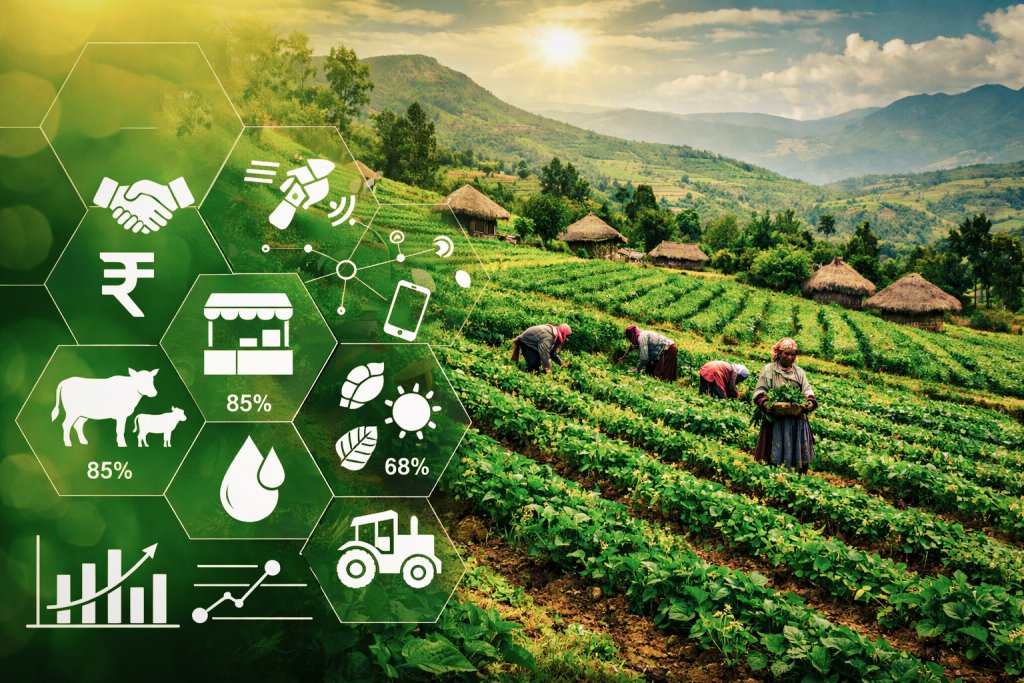
From teff fields in the highlands to vegetable farms supplying urban markets, millions of families depend on agriculture for income and stability. Yet despite its central role, agricultural markets often struggle to function efficiently and inclusively.
For years, many efforts focused on increasing production. Improved seeds, fertilizer distribution, and farmer training were seen as the main pathways to growth. These efforts matter. But over time, it has become clear that productivity alone does not solve the deeper constraints farmers face. The real challenge often lies in how the system around them works.
In Ethiopia, smallholder farmers frequently face unpredictable prices, limited access to reliable buyers, weak information flows, and constrained access to finance. A good harvest does not always translate into better income. Markets are fragmented. Trust between actors can be fragile. Risk is high across the value chain.
This is where AgTech becomes relevant, not as a trendy digital solution, but as part of a broader market systems conversation.
When a farmer in a rural Ethiopia uses a mobile phone to check market prices before transporting produce, that is not simply technology adoption. It is improved information flow within the system. When digital platforms connect producers to urban buyers, transaction costs decrease and transparency increases. When digital records of sales are created, financial institutions have better data to assess creditworthiness. These shifts may seem small, but together they reshape incentives.
Market Systems programs in Ethiopia aim to address constraints at this systemic level. Instead of delivering services directly and indefinitely, they ask how private actors can sustainably provide solutions. They look at supporting functions such as finance, information, logistics, and technology. AgTech strengthens many of these functions.
For example, digital advisory services can complement the public extension system, expanding access to timely agronomic advice for farmers. Weather and climate information services delivered through mobile platforms help producers make better decisions on planting, irrigation, and harvesting. Digital payment systems reduce the risks associated with cash transactions while helping farmers build financial histories that can unlock access to credit. E-commerce and digital trading platforms connect producers to traders, processors, and urban markets, reducing information asymmetry and improving price discovery.
AgTech tools are also transforming farm management and supply chains. Remote sensing and satellite-based crop monitoring allow agribusinesses and cooperatives to assess crop performance and anticipate risks. Digital input platforms help farmers access quality seeds, fertilizers, and veterinary products while improving transparency in input markets. Traceability and digital record systems help exporters meet international standards, opening access to higher-value markets and strengthening trust with buyers. Meanwhile, data-driven insurance products such as index-based crop insurance help farmers manage climate-related risks.
Each of these tools, when commercially viable and embedded within the broader market system, can strengthen relationships between farmers, service providers, and financial institutions
However, Ethiopia also reminds us that technology alone is not enough. Connectivity varies across regions. Smartphone penetration is growing but not universal. Women in rural areas may have less access to digital devices and financial services. Youth may be more digitally literate, yet lack capital to invest. If AgTech solutions are not designed with these realities in mind, they risk reinforcing existing inequalities.
A market systems lens pushes us to ask harder questions. Who owns the phone in the household. Who controls income from sales. Who decides whether to adopt a new service. What business model ensures that a digital platform survives without continuous donor funding. These questions are just as important as the technology itself.
Ethiopia’s digital agricultural transformation will not come from apps alone. It will come from stronger relationships between farmers, buyers, financial institutions, and service providers. It will come from aligned incentives and shared value. AgTech, when embedded within Market Systems programs, can accelerate this alignment. It can make markets more transparent, reduce risk, and unlock investment.
The real opportunity lies in using technology to strengthen the invisible infrastructure of the market. When information flows more freely, when finance becomes more accessible, and when trust increases across value chains, farmers are better positioned to translate their hard work into sustainable income.
In Ethiopia, the intersection of AgTech and Market Systems programs is not about digital transformation for its own sake. It is about building agricultural markets that work better for everyone.
Leave a Reply